

 Catherine Stebbins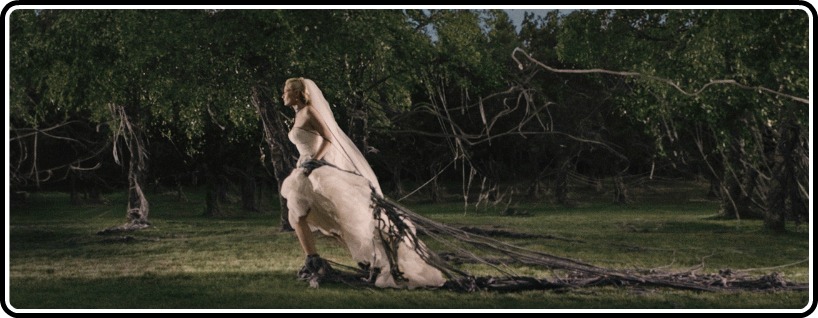
This review does contain spoilers
It may seem contradictory to say that Lars von Trier’s end-of-the world opus is the director as his most peaceful and life-affirming; but it is. This isn’t to say that Melancholia is sunshine and rainbows; just look at the title and basic plot synopsis. But this is the Danish auteur reaching out and making a human connection with his audience as much as he likely ever will. It is a meditative exploration of the unexpectedly dichotomous nature (and the ways the two converge) between depression that renders one immobile in life, and having to face that which we will all eventually come to meet; death.
The film is split into two equal parts, both of which take place at a remote castle. The first part, titled Justine after Kirsten Dunst’s troubled character, illustrates the night of her wedding reception. The second part is titled after Justine’s sister Claire as played by Charlotte Gainsbourg. It also takes place at the castle, during the five days before the planet Melancholia’s supposed fly-by passing. Claire becomes convinced the planet will collide with our own while Justine, who is visiting due to her debilitating state of depression, remains indifferent by the idea of human existence coming to an end.
The first part, Justine’s wedding, is not concerned with the apocalypse at all but with the bride’s gradual and inescapable slide into what are obviously long standing depressive habits. Von Trier and Dunst are unapologetic in their collaborative exploration of depression which stands as one of the most realistic and honest looks at the condition I have ever seen.
She starts out apparently effervescent on her way to her wedding reception. She is married to Michael, her hapless and misguidedly devoted husband (Alexander Skarsgaard). They share some amusing moments as their limousine has great difficulties making it up a hill on the way to the castle. As the wedding progresses, we get some wonderfully odd-ball humor (including the genius casting of Udo Kier as a wedding planner), these minute absurdist moments that hint at dense and complex family histories. We come to see she is nearly surrounded by toxicity in both her family and work.
This is not used as an explanation for Justine’s depression; that none is really given is what the film so resonantly depicts about the illness. When you suffer from depression, there is often no direct cause for that state of mind. The film refuses to explain Justine’s actions or mood swings and that is what strikes true about it. She is monumentally dragged down by mere factual existence and the necessity required by living. Hell, it renders her damn near immobile. As the film progresses, we realize that her radiance at the film’s start is far from the norm for her. Eventually, it becomes a wonder that we ever saw her smiling in the first place.
Justine’s regroup efforts as the night progresses are futile and account to mere moments of barely pulling herself together for a forced smile or any sustained human interaction. Her efforts manifest themselves in moments of fierce agency, cruel neglect or hushed unsuccessful cries for help to both her parents (a caustic Charlotte Rampling and a gleefully vapid John Hurt). Dunst and Trier, both having first-hand experience with depression, make painstaking connections with Justine that culminate in an uncompromising understanding and loyalty to her. They are unwilling to cater to standard rules of characterization or to apologize for the frustration and lack of sympathy she can elicit. For those of us who know what bouts of depression are like, this reveals it in all of its extreme truths and ugliness. Von Trier’s previous film Antichrist was made as he went through a severe depression, and no matter what one thinks of that work, looking at Melancholia in the context of a follow-up to his previous film will make for worthwhile discourse someday.
Von Trier further illuminates the main focuses from his first half by carrying it through the second. Juxtaposed are Justine’s now barely functional self (and the theme of depression) against Claire’s increasingly fragile state as her very correct fear of doomsday approaches (the theme of approaching death).
Even though Claire’s very relatable state-of-mind headlines the second half,it is more focused on the ways that Justine, Claire and her husband John (Kiefer Sutherland) come to terms (or don’t) with death as it considers humanity’s various approaches to our ultimate fate. Justine is indifferent and entirely okay with Earth being extinguished. She is more than capable of handling oncoming death; life is her weakness. She remains calm in the face of expulsion, as the roles between her and Claire reverse by the end; Claire is dependent on Justine for support and Justine becomes her protector in their final moments. Claire is anxious but keeps a stiff upper lip for her husband and son as well as taking care of Justine. Once the disaster is confirmed, Claire desperately seeks escape but it is useless; she faces death with heaving sobs of fright. Her character’s journey is the one that audiences will most relate to; she provides the emotional core of the film.
Then we have poor denial ridden John. John is going the rational route, citing scientists’ claims as well as his own observations as an astronomy enthusiast, that Melancholia will simply fly-by. He is excited for the event, and the once-in-a-lifetime experience of unique beauty that it offers. On the side, John starts to stock up on some supplies. He slowly becomes privy to the direness of the situation at hand and chooses to handle it with yet another possible human response to knowing of one’s own end.
Lars von Trier is hyperaware of the pointlessness of it all and he deals with Armageddon in a similarly matter-of-fact way. There is no silver lining here. But he does give Justine an essential transformative moment in its final scenes that signify a kind of catharsis on von Trier’s part through Dunst’s character. She is unable to muster together any kind of catering sympathy for Claire who needs consoling to the umpteenth degree. The world is going to end. She is upset. Her son will not get to grow up. Everything will end. But Justine spews nihilism at Claire, mocking her final wish to ritualize their deaths through being together on the patio and holding hands (amusingly enough, I cannot remember if the latter was Claire’s suggestion or Justine’s mocking).
Throughout the film, Justine actively seeks out Claire’s son Leo (Cameron Spurr) who she has a connection with (Leo does the same in seeking her out in separate moments). Their moments together earlier in the film set up Justine’s selfless act. She pulls it together in their final moments on Earth, facilitating the illusion of a protective magic cave for Leo as they use sticks to build their haven. Justine’s empathy extends even to Claire and their symbolic cave functions as the ritual that Claire so badly needed (though she is still a wreck as the end arrives). At the very end of the film, Justine looks at Claire in a way that shows an appreciation on Justine’s part for her sister, for being with her at the end and a coming-to-terms with life, death, and everything in between. It shows she is capable of emotion that she never expected to have. For as great as Dunst is in this film, and believe that she is as great as everyone says, these final moments are her best work to date. There is so much happening there on the inner workings of her face, so much being said in her looks, that they serve as the film’s climax rather than the physical destruction surrounding them as Melancholia collides with Earth.
There is an opening montage that serves as a sort of ‘˜greatest hits’ of what is to come. Moments are captured in time using the ultra-slow-motion method that similarly opens Antichrist. Some of these moments we see, some we do not and some never happen but are representational of something a character describes or sees. Right off the bat we are sucked in by these shots that function as beauty incarnate and as the visual tapestry of what this film is getting at.
Also notable is the distinct sense of place that will be immediately recallable as time goes by. Instead of taking the typical broad approach to depicting disaster via widening scope, Melancholia‘s world is within one castle in its entire Baroque, romantic and otherworldly glory. Using Wagner’s Tristan and Isolde prelude for the music is perfect; it gives everything an appropriately pastoral quality and a peripheral imprint of something coming that cannot be pushed back. It is not overly present, but it is a quality in the music that is just enough for the pastoral purity to be ruffled. There is an utter lack of technology to be found. Outside of Claire stumbling onto an archaic looking website that charts out Melancholia’s ‘˜Dance of Death’, nobody is glued to their TV sets, frantically looking online for updates, listening to the radio or even making phone calls to loved ones. Von Trier goes entirely against the grain here by pushing out the use of news footage and technology in relation to a cataclysmic event. We hear about what scientists are saying, not because of any communal anxiety we see, but through John’s word-of-mouth dialogue. Though John has a telescope, the primary tool Claire uses to see if the planet is moving farther or closer to Earth is a simple handmade device that John and Leo made together. Finally to top off the distinct sense of place, the remarkable cinematography by fellow Danish filmmaker Christoffer Boe’s regular DP Manuel Alberto Claro utilizes hand-held camera and alternates close-ups with a distant eye to magnificent effect.
Melancholia is one of those films that successfully fulfill their ambitions in dealing with profound and fundamental subject matter on a grand level of intellectual-based intuition. You come away with, yes lots to talk about, but just as importantly, a feeling that a filmmaker has come upon something almost indescribable that gets at how we experience life, death and what it all means (or ultimately doesn’t mean). Synecdoche, New York is one of these films. This year’s The Tree of Life is another. Some might call these films pretentious but this is reductive and dismissive. Lars von Trier’s latest film is his most accessible, but is no less thought-provoking. In fact, if there is one film that will temporarily win over his detractors, it would be this one. It takes us through the cathartic process of grieving mankind with a scrutinizing look at depression, death, acceptance and world annihilation with an uncharacteristically humanistic eye.